Company deregistered? Getting it back is quick.
The application is the quick part. What follows is 30 business days to file everything the company owes, or it goes back to deregistered. We handle both ends.

Free status check. No obligation. We respond within one business day.
.png "Untitled design (1)")
Where reinstatements go wrong
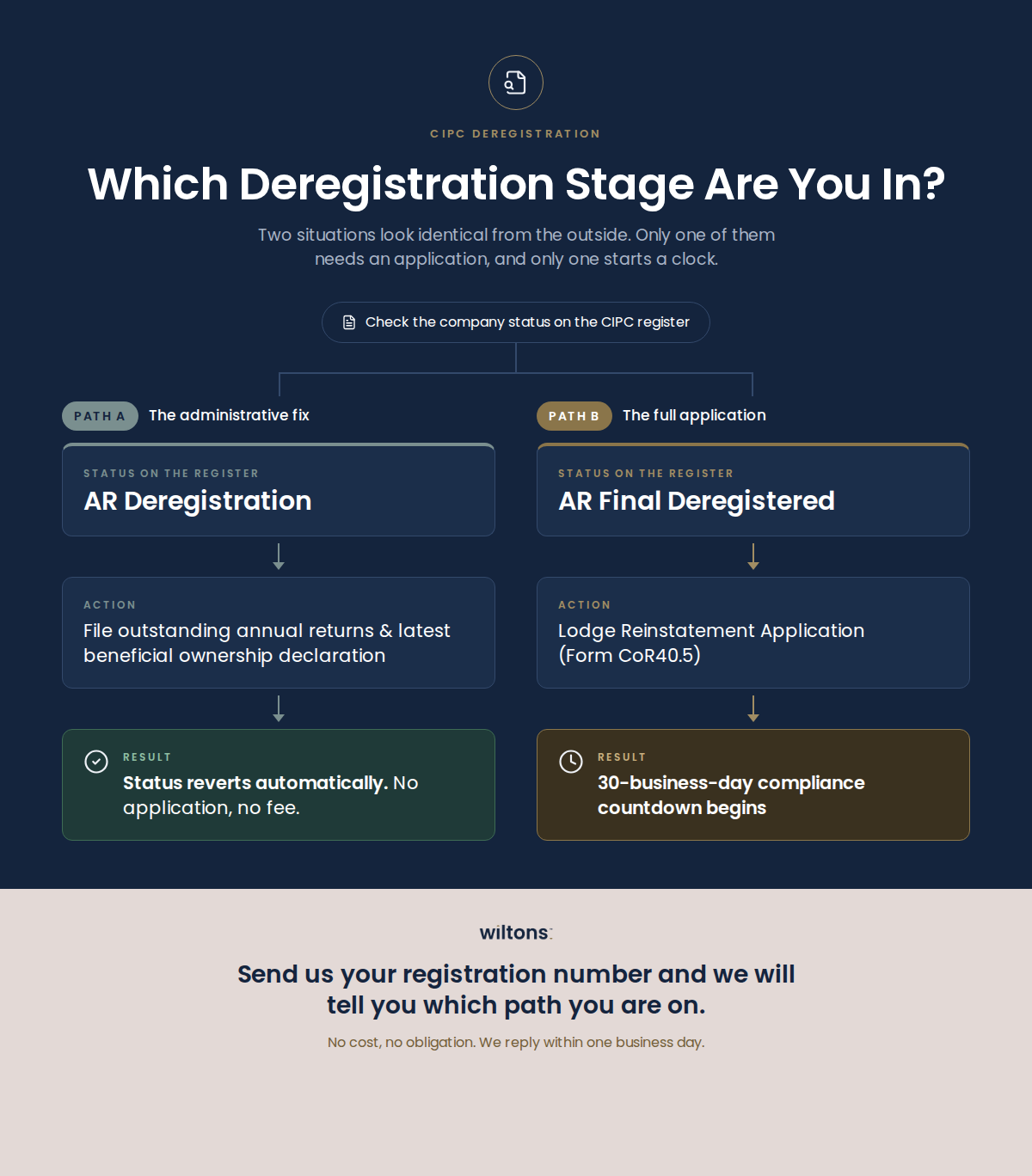
Starting in the wrong place. Two CIPC statuses look identical and call for completely different work. "AR Deregistration" means the company is still on the register: file the outstanding returns and the beneficial ownership declaration and the status reverts on its own. No application, no application fee. "AR Final Deregistered" means the company is off the register and needs a full Form CoR40.5 application. Get this wrong and you either pay for an application you never needed, or you file returns that cannot land.
Stopping at the reinstatement notice. The notice arrives, it feels finished, and everyone moves on. You actually have 30 business days from that point to file every outstanding annual return, the latest beneficial ownership declaration and any outstanding financial statements. Miss the window and CIPC returns the company to its previous deregistered status. You lodge again, you pay again, and six weeks are gone.
Nobody owning the follow-through. The application takes an afternoon. The filings that come after it take weeks of chasing records, signatures and old financials, usually while the business is dealing with whatever the deregistration was blocking in the first place.
How we handle it: we confirm the company's actual status before anything is paid for, lodge within five business days of your first call, and hold the file until every filing in the 30 business day window is in and confirmed.
A company deregistered by CIPC loses its legal status. It cannot contract, it cannot hold a bank account, and it cannot trade. Its directors can be left personally exposed for its debts.
Almost nobody finds out from CIPC. It surfaces at the worst possible moment: a frozen bank account, a stalled transaction, a tender disqualification, or a buyer running due diligence who comes back with a status nobody in the business knew about.
Why it happens
CIPC refers a company for deregistration where its annual returns have been outstanding for two successive years. Beneficial ownership non-compliance is picked up by the same automated referral process. It does not take a dramatic failure. It takes two quiet years.
Thirty business days to file everything you owe.
CIPC processes the reinstatement, and a clock starts. Within 30 business days, roughly six weeks, the company must file:
- Every outstanding annual return, for every year missed
- The latest beneficial ownership declaration
- Any outstanding annual financial statements, or the financial accountability supplement where that applies.
Miss the window and CIPC returns the company to its previous deregistered status. You lodge again, you pay again, and roughly six weeks are gone.
This is where self-managed reinstatements come undone. Not at the application. At the follow-through, when the reinstatement notice has arrived, everyone has moved on, and the filings that were the whole point of the exercise quietly do not happen.
Does the company qualify?
Administrative reinstatement is not available to every deregistered entity. CIPC applies one gate:
The entity must have been in business, or have held any economic value, at the time of its final deregistration.
Immovable property registered in the company name also qualifies it, whether or not the company was trading.
Where the entity was dormant and held nothing, administrative reinstatement is not the route. A section 83(4) court order is, and we set that out further down this page.
First does the company qualify?
Administrative reinstatement is not available to every deregistered entity. CIPC applies one gate:
The entity must have been in business, or have held any economic value, at the time of its final deregistration.
Immovable property registered in the company name also qualifies it, whether or not the company was trading.
Where the entity was dormant and held nothing, administrative reinstatement is not the route. A section 83(4) court order is, and we set that out further down this page.
Who is entitled to apply
Any interested person may apply for reinstatement, including a creditor who needs the company back on the register to pursue a claim.
There is a practical limit on that. Where the applicant is neither the company nor its duly appointed representative, CIPC advises that the reinstatement be done by court order rather than by administrative application. If you are a third party, plan for the court route rather than assuming the online one.
Entity types:
The process applies across CIPC-registered entity types:
- Private company, (Pty) Ltd, registration code 07
- Public company, Ltd, registration code 06
- Personal liability company, Inc., registration code 21
- Non-profit company, NPC, registration code 08
- State owned company, SOC, registration code 30
- Close corporations
Since August 2025 the reinstatement application runs entirely online, and CIPC processes it as soon as payment clears.
Two things that catch people out
The dedicated reinstatement email address closed on 11 August 2025. Applications sent to it are not received. If a checklist or a template you are working from still refers to emailing CIPC, it is out of date.
Submission is not filing. The application only counts as filed once the payment has gone through. An application captured but not paid for sits and does nothing.
The removal of the document upload requirement is the single most misread change to this process. It does not mean CIPC has stopped caring about evidence. It means CIPC is no longer collecting it upfront.
The supporting evidence must exist, and it must be retained. CIPC may call for it at any time, and an application that cannot be backed up when asked is an application that gets undone.
Bank statements covering roughly six months either side of the deregistration date are the usual starting point for showing that the company was in business or held economic value.
What is no longer required
The Deeds Office searches and the Department of Public Works letter fell away on 1 January 2022. If someone has quoted you for either, the quote is running on old information.
What reinstatement does to the past.
The company is treated as though it was never removed.
Administrative reinstatement under section 82(4) is retrospective to the date of deregistration. It validates the corporate activity that took place while the company was off the register, which matters if the business carried on trading, signing and banking without knowing
The company keeps its original name and registration number.
That is not absolute. A third party who is prejudiced by the reinstatement may approach the court for relief under section 83(4). Where a transaction during the deregistered period is contested, or a creditor has acted on the deregistration, take advice rather than assuming the reinstatement settles it.
Source - Newlands Surgical Clinic v Peninsula Eye Clinic 2015 (4) SA 34 (SCA)
What reinstatement does to the past? The company is treated as though it was never removed.
Administrative reinstatement under section 82(4) is retrospective to the date of deregistration. It validates the corporate activity that took place while the company was off the register, which matters if the business carried on trading, signing and banking without knowing
There is a practical limit on that. Where the applicant is neither the company nor its duly appointed representative, CIPC advises that the reinstatement be done by court order rather than by administrative application. If you are a third party, plan for the court route rather than assuming the online one.
The company keeps its original name and registration number.
That is not absolute. A third party who is prejudiced by the reinstatement may approach the court for relief under section 83(4). Where a transaction during the deregistered period is contested, or a creditor has acted on the deregistration, take advice rather than assuming the reinstatement settles it.
Source - Newlands Surgical Clinic v Peninsula Eye Clinic 2015 (4) SA 34 (SCA)
The court order route. When the online route is not available.
Some reinstatements have to go through the High Court on a section 83(4) application. Typically:
- The applicant is neither the company nor its duly appointed representative
- The entity was dormant and held no economic value at final deregistration
- A third party is prejudiced by the reinstatement, or contests it
The order is uploaded onto the CIPC online service. It is not emailed, and it is not lodged at a counter.
One thing to get right the first time: CIPC implements a court order once. If the order does not deal with everything it needs to deal with, going back for a second bite means going back to court. That makes the drafting of the order the point at which this route is won or lost.
CIPC charges no fee where the application rests on a court order. The court and legal costs are a separate matter.
The court order route? When the online is not available.
Some reinstatements have to go through the High Court on a section 83(4) application. Typically:
- The applicant is neither the company nor its duly appointed representative
- The entity was dormant and held no economic value at final deregistration
- A third party is prejudiced by the reinstatement, or contests it
The order is uploaded onto the CIPC online service. It is not emailed, and it is not lodged at a counter.
One thing to get right the first time: CIPC implements a court order once. If the order does not deal with everything it needs to deal with, going back for a second bite means going back to court. That makes the drafting of the order the point at which this route is won or lost.
CIPC charges no fee where the application rests on a court order. The court and legal costs are a separate matter.
1. Status check
We confirm where the company actually stands at CIPC and tell you which of the two situations above you are in. No cost, no obligation
2. Eligibility and evidence
We check whether the entity qualifies for administrative reinstatement, and tell you what evidence you need to be able to produce if CIPC asks for it later.
3. Lodgement
We prepare and lodge the CoR40.5 and see the payment through. Where the file is clean, we lodge within five business days of your first call.
4. The 30 business day programme
We hold the file and close out every outstanding annual return, the beneficial ownership declaration and any outstanding financial statements inside the window. You get confirmation of each filing as it goes in.
5. Keeping it clean
Ongoing corporate secretarial support, so the next annual return is filed on time and this does not happen twice.

For over 50 years, Wiltons has handled company registration, secretarial, tax, VAT, payroll and financial reporting for local and international businesses operating in South Africa. Two generations of navigating CIPC and SARS means that when your company needs reinstating, you're working with a team that's done it hundreds of times - not learning on your file.
My business is
based in South
Africa
Book your no-obligation consultation
with Lingum Govender.